
Trenchless sewer repair and traditional sewer digging are two ways to fix a damaged sewer line. Trenchless work uses minimal excavation with small access points, while traditional digging uses full excavation. Costs, pros, and cons depend on disruption, pipe condition, and access. This guide compares both methods and helps a homeowner choose the right repair method.
What is the difference between trenchless sewer repair and traditional digging?
Trenchless sewer repair fixes damaged pipes with minimal excavation, while traditional digging requires opening the ground to fully access and replace the sewer line.
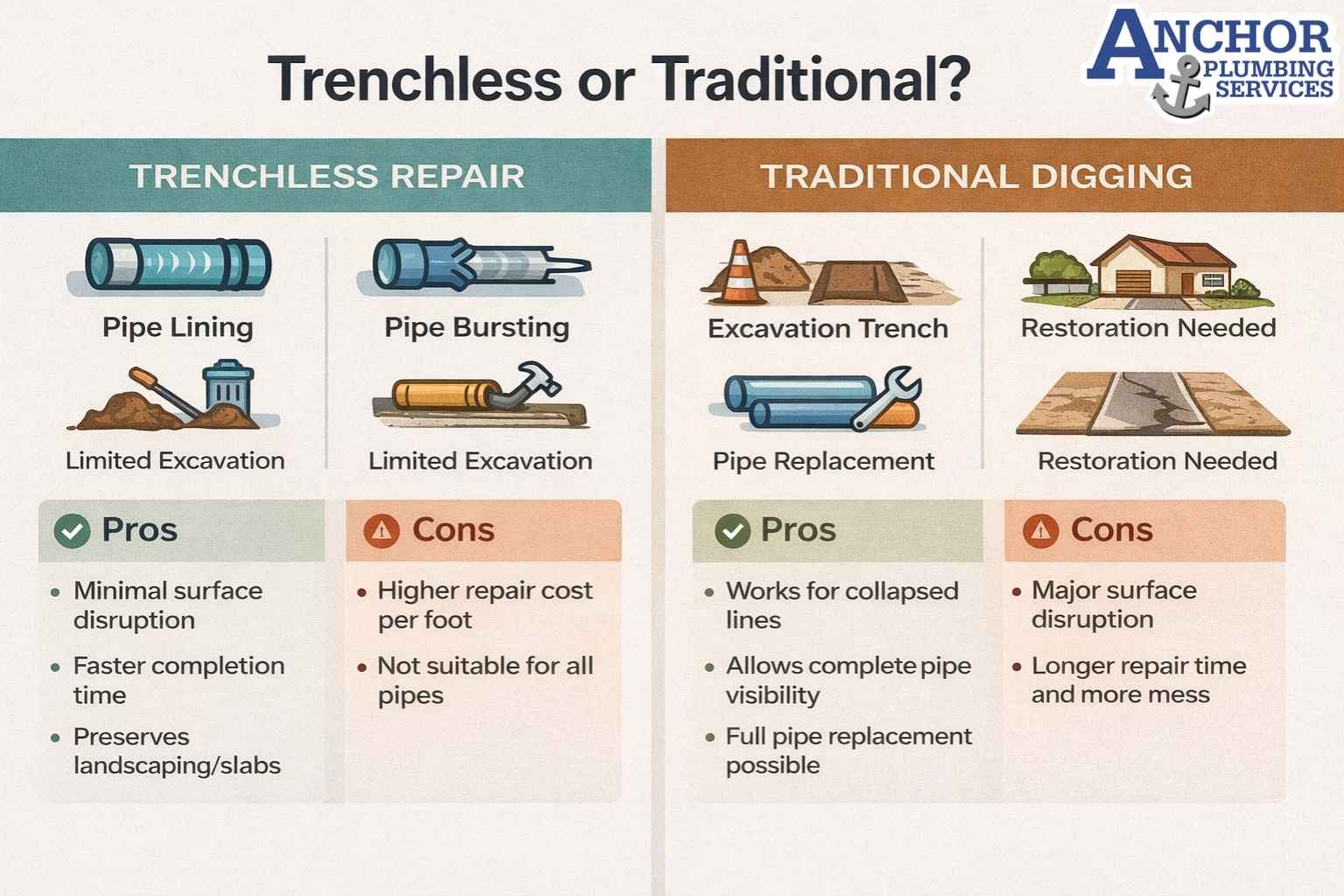
Trenchless sewer repair includes pipe lining and pipe bursting. Pipe lining installs a resin liner inside the existing sewer line to create a new interior pipe wall, and it is commonly used when the existing pipe is not severely damaged. Pipe bursting breaks the old pipe while pulling a new pipe into place through entry and exit points, which adds steps and cost compared with lining alone.
Traditional sewer digging involves open trench excavation. The ground is excavated along the sewer trench so the crew can expose the full pipe, remove damaged sections, and replace the sewer line directly. Because the entire trench length is opened, surface disruption is usually higher.
Access method affects cost, disruption, and timeline. Trenchless work typically limits digging to key points but may still require minor excavation at the street or where the line enters the home, plus extra labor for obstacles like roots. Traditional excavation increases restoration needs, especially under driveways or sidewalks, which can raise the total project cost.
How much does trenchless sewer repair cost compared to traditional digging?
Trenchless sewer repair often has a higher upfront price per foot, but total project cost is frequently lower than traditional digging due to reduced labor, restoration, and property damage.
Trenchless pricing is commonly tied to the method. Sewer pipe lining often runs $135 to $150 per linear foot when the existing pipe is not severely damaged. Pipe bursting with lining can increase cost to $150 to $190 per linear foot because the old pipe must be broken apart before the new pipe is installed.
Traditional digging can look cheaper when you only compare pipe materials, but the project cost increases when excavation and restoration are added. When a sewer lateral runs under a driveway, garage slab, or sidewalk, restoration can add thousands to the bill because concrete and landscaping must be rebuilt after the trench is closed.
Trenchless can cost less overall because it usually avoids replacing large surfaces. It also tends to shorten the project timeline because there is less soil removal and less restoration work.
Final cost varies based on inspection findings. Permits can add expenses, and camera inspections may be included or added depending on the scope. One cost guide notes sewer permits can reach up to $1,000 and camera inspections can range $175 to $350 in some markets.
What are the pros and cons of trenchless sewer repair?
Trenchless sewer repair reduces property damage and repair time but is not suitable for every pipe condition.
Pros of trenchless sewer repair
- Minimal surface disruption because work uses access points instead of a full trench
- Faster completion in many homes because restoration work is limited
- Preserves landscaping, driveways, and slabs that would otherwise be removed and replaced
- Less daily disruption for the homeowner due to smaller work areas
Cons of trenchless sewer repair
- Higher upfront repair cost per linear foot for lining and bursting methods
- Not suitable for major structural failure such as a collapsed pipe, severe shifting, or improper slope
- Requires a pipe that is structurally intact enough to line, or conditions that allow bursting
- Limited by pipe material, diameter, and the need for entry and exit access points
What are the pros and cons of traditional sewer digging?
Traditional sewer digging allows full pipe replacement but causes significant surface damage and longer repair timelines.
Pros of traditional sewer digging
- Full visibility of the sewer line because excavation exposes the pipe path
- Suitable for collapsed or severely damaged pipes where lining is not possible
- Allows complete pipe replacement and grade correction when slope is wrong
- Works across more soil and pipe conditions when access is the main constraint
Cons of traditional sewer digging
- Extensive excavation that disrupts the yard and hard surfaces
- Higher restoration scope when trenches cross driveways, sidewalks, patios, or slabs
- Longer overall duration because restoration follows the plumbing work
- Higher disruption for the homeowner due to open trench length and work area size
What risks are associated with each sewer repair method?
Each sewer repair method has risks that affect safety, accuracy, and property impact, not just price.
Trenchless risks start with inspection accuracy. Pipe lining can fail early if the host pipe condition is misjudged, such as unseen breaks, heavy deformation, or an internal blockage that prevents a full seal. A trenchless specification guideline notes that if inspection reveals an obstruction, misalignment, broken, or collapsed section that prohibits proper installation, open cut repair may be required before lining can proceed.
Traditional digging risks are tied to excavation and surface area affected. Full trench excavation can damage landscaping, irrigation, hardscape, and nearby structures if soil support changes during digging. Downtime can increase because the work includes excavation, pipe replacement, backfill, compaction, and restoration. Restoration costs rise when the trench crosses concrete, pavers, or mature landscaping, since the surface must be rebuilt after the sewer line is restored.
Depth also changes risk. Deeper lines increase excavation complexity, spoil handling, and safety controls, which can extend the timeline and increase disruption.
When is trenchless sewer repair the better option?
Trenchless sewer repair is usually the better option when the sewer line is damaged but still intact enough for a liner or replacement pull.
This option fits best when the pipe is cracked, has joint leaks, or shows root intrusion, but there is no full collapse and no severe shifting. A homeowner also benefits when minimal disruption matters, such as a line that runs under landscaping, a driveway, or a slab area that would be expensive to restore.
Trenchless also fits when inspection shows acceptable alignment. Small offsets and minor deformation can be workable, but the line must still support a continuous repair path. Inspection findings determine qualification, so a camera inspection and a clear condition assessment are the decision point. Planning for unexpected findings matters because hidden blockages, roots, or collapsed sections can change the repair plan after the line is viewed.
When is traditional sewer digging necessary?
Traditional sewer digging is necessary when the sewer line condition prevents a reliable trenchless installation or when the pipe path must be corrected.
Excavation becomes the required method when there are collapsed pipe sections, severe offsets, or a pipe belly that holds water and blocks proper flow. Major structural failure like a collapsed line, severe shifting, or improper slope is a common replacement trigger because the grade and pipe bed often need correction, not just a new interior surface.
Traditional digging is also necessary when pipe material transitions create connection issues, or when there are no viable access points for trenchless equipment. If cleanouts are missing, access is blocked, or the line route cannot support entry and exit points, excavation may be the only way to expose the trench and replace the sewer line safely.
The decision is driven by severity and accessibility. The more collapse or misalignment present, the more traditional digging mandates full exposure and direct replacement.
How do plumbers decide between trenchless repair and traditional digging?
Plumbers decide between trenchless repair and traditional digging by inspecting the sewer line condition, confirming pipe material and age, and evaluating depth and access before recommending the most reliable long term fix.
A sewer camera inspection provides visibility inside the line, which improves diagnosis accuracy and supports a realistic repair plan and price estimate. During inspection, a plumber looks for cracks, offsets, root intrusion, bellies, and collapse indicators that affect whether a liner can seal correctly or whether full exposure is required.
Pipe material and age matter because older or outdated materials can fail in multiple places, which shifts the recommendation from a localized repair to replacement. Depth and access evaluation matters because trenchless equipment still needs entry and exit points, and the work area must be accessible with utilities and landscape features identified.
If inspection shows major problems like collapse or improper slope, trenchless methods are often not suitable and excavation becomes the dependable option.
How does Anchor Plumbing Services handle sewer repair in San Antonio?
Anchor Plumbing Services handles sewer repair in San Antonio by starting with camera inspection and diagnosis, then explaining trenchless sewer repair and traditional sewer excavation options in plain language so the homeowner can choose based on disruption, longevity, and budget.
Our team provides trenchless sewer repair, traditional sewer digging, and sewer line replacement. We focus on matching the repair method to pipe condition and access, not convenience. If a liner is a good fit, we plan access points and confirm the line can support a durable seal. If the line is collapsed, severely offset, or needs grade correction, we recommend excavation and replacement for reliable flow restoration.
Every job is led by a Master Plumber and completed by a Texas licensed, insured team. You receive flat rate pricing and a written quote before work begins. We also offer 24 hour emergency service for urgent sewer backups and active leaks.
Anchor Plumbing Services serves San Antonio, Helotes, New Braunfels, Stone Oak, West San Antonio, and Northwest San Antonio, with clean job sites, clear communication, and final testing to confirm the system is restored.