

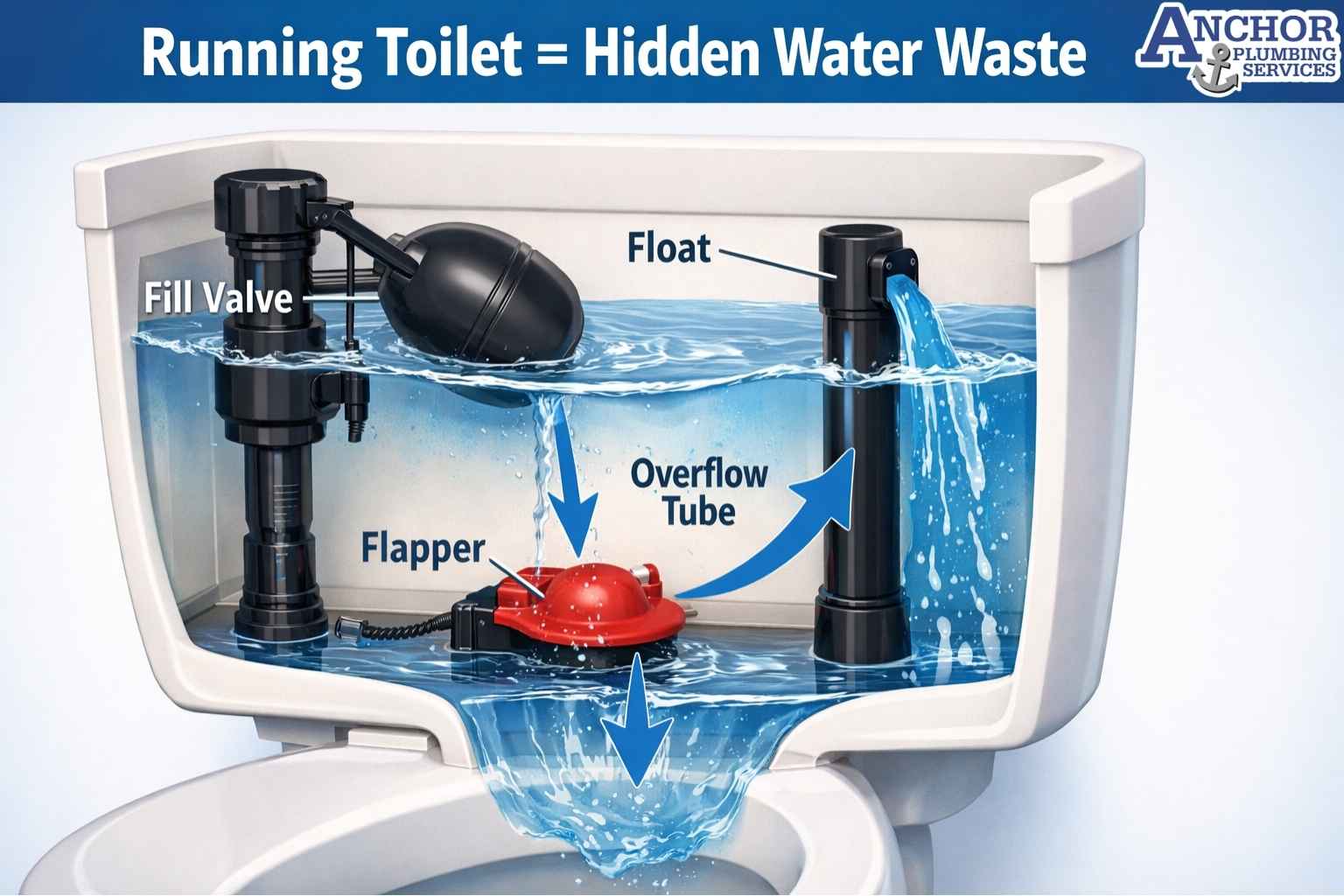
A running toilet wastes up to 200 gallons of water per day. That equals 6,000 gallons per month — enough to add $20–$40 to your water bill without a single visible leak. Six mechanical components inside the toilet tank are responsible for 95% of running toilet cases. Most repairs cost between $10 and $250 depending on the failed part.
What Is a Running Toilet and How Does It Waste Water?
A running toilet is one where water continuously flows from the tank into the bowl or overflow tube without stopping between flushes. The toilet tank refill cycle never fully completes. Water keeps entering the bowl even when no flush has occurred.
Three components control the tank refill cycle. The flapper seals the flush valve opening at the bottom of the tank. The fill valve controls water flow into the tank after a flush. The float rises with the water level and signals the fill valve to stop. When any of these three components fail, the refill cycle does not terminate — and the toilet runs continuously.
According to the EPA’s WaterSense program, a single running toilet wastes up to 200 gallons per day. At San Antonio Water System (SAWS) average residential rates, that translates to approximately $24 per month in wasted water for a toilet that runs constantly.
What Are the 6 Most Common Causes of a Running Toilet?
Six components account for running toilets in the overwhelming majority of cases:
- Worn or warped flapper valve — the flapper no longer seals the flush valve seat, allowing water to leak continuously into the bowl
- Faulty fill valve — a worn fill valve fails to shut off water flow after the tank reaches capacity
- Incorrect float height — a float set too high causes water to spill into the overflow tube before the fill valve shuts off
- Damaged overflow tube — a cracked or incorrectly sized overflow tube drains water before the tank fills to the correct level
- Corroded or scaled flush valve seat — mineral deposits or corrosion prevent the flapper from seating flush against the valve opening
- Loose or broken toilet handle chain — a chain with excess slack, a tangle, or a break keeps the flapper from closing fully after a flush
Each cause produces the same symptom — a toilet that runs — but requires a different diagnosis and repair approach.
How Does a Worn Flapper Cause a Toilet to Keep Running?
A worn flapper is responsible for running toilets in approximately 80% of cases. The flapper is a rubber seal attached to the overflow tube that covers the flush valve opening at the base of the tank. When the flapper degrades, it no longer seats flush against the valve — and water leaks continuously from the tank into the bowl.
Rubber flappers degrade from 3 sources: chlorine in municipal water, prolonged heat exposure, and normal wear over time. Average flapper lifespan is 4–5 years. San Antonio’s municipal water supply contains residual chlorine for disinfection, which accelerates rubber degradation and reduces flapper lifespan closer to 3–4 years for many households.
How to confirm a flapper leak: Add 5–10 drops of food coloring to the toilet tank. Wait 15 minutes without flushing. If color appears in the bowl, the flapper is leaking.
How to replace a toilet flapper:
- Turn off the water supply valve behind the toilet
- Flush to drain the tank
- Unhook the flapper ears from the overflow tube pegs
- Disconnect the chain from the flush handle arm
- Attach the new flapper to the overflow tube pegs and reconnect the chain
- Turn the supply valve back on and test
Replacement flappers cost $5–$15 at hardware stores. The repair takes 10–15 minutes and requires no tools. If toilet and drain issues extend beyond the tank, a licensed plumber can assess both systems during the same visit.
How Does a Faulty Fill Valve Cause a Running Toilet?
A faulty fill valve causes a running toilet by failing to shut off water flow once the tank reaches its set water level. The fill valve — also called a ballcock assembly on older toilets — contains an internal diaphragm or float mechanism that triggers the shutoff. When that mechanism wears out, the valve stays partially open and water continues entering the tank indefinitely.
The most common audible sign of a failing fill valve is a hissing sound from inside the tank. The hiss occurs when the valve fails to close fully after a flush cycle.
Fill valve lifespan averages 5–7 years under standard conditions. San Antonio’s hard water — averaging 15–20 grains per gallon — accelerates mineral buildup on the valve seat and diaphragm, reducing functional lifespan compared to areas with softer municipal water.
How to replace a fill valve:
- Turn off the supply valve and flush to empty the tank
- Disconnect the supply line from the bottom of the tank
- Unscrew the locknut securing the fill valve to the tank base
- Lift out the old valve and insert the new one
- Adjust the height so the critical level mark sits 1 inch above the overflow tube
- Reconnect the supply line, turn the water on, and test
Fill valve replacement parts cost $10–$30. Professional repair runs $100–$175 including labor in San Antonio.
How Does an Incorrect Float Height Keep a Toilet Running?
An incorrect float height causes a running toilet when the water level in the tank rises above the top of the overflow tube. Water spills directly into the overflow tube and drains into the bowl continuously — even when the flapper and fill valve are functioning correctly.
The float is the component that signals the fill valve to stop. On older toilets, the float is a ball attached to a horizontal arm. On newer toilets, it is a cup that slides along the fill valve body. In both designs, the float must be calibrated so the fill valve shuts off before the water level reaches the overflow tube opening.
The correct water level in a standard toilet tank sits ½ to 1 inch below the top of the overflow tube.
How to adjust a ball-float system: Bend the float arm downward until the water stops at the correct level.
How to adjust a cup-float system: Turn the adjustment screw or pinch and slide the adjustment clip downward on the fill valve body.
Float adjustment requires no parts and no tools in most cases. It takes under 5 minutes.
How Does a Damaged Overflow Tube Cause Water to Keep Running?
A damaged overflow tube causes continuous draining when it develops a crack or when a previous repair installed a tube of incorrect height. The overflow tube is a vertical plastic cylinder inside the tank. Its function is to prevent tank overflow by directing excess water into the bowl. When it is cracked or set too short, water drains through it before the tank reaches operating capacity.
A cracked overflow tube is part of the flush valve assembly — a single integrated unit that includes the flush valve seat, overflow tube, and mounting hardware. Replacing the flush valve assembly requires full tank disassembly.
Flush valve assembly replacement cost:
- Parts: $15–$40
- Professional repair: $100–$200 including labor in San Antonio
Distinguishing a damaged overflow tube from a float calibration issue is straightforward. If adjusting the float height does not stop the running, and the water level sits below the overflow tube opening, the tube itself requires inspection for cracks.
How Do a Corroded Flush Valve Seat and Faulty Chain Cause a Running Toilet?
Corroded flush valve seat: The flush valve seat is the opening at the base of the tank that the flapper seals against. Mineral deposits from hard water accumulate on the seat surface over time, creating an uneven rim that prevents the flapper from seating flush. Water leaks past the imperfect seal continuously.
San Antonio’s water hardness of 15–20 grains per gallon accelerates mineral accumulation on valve seats compared to the national average of 7–10 GPG. A plumber can resurface minor buildup with a repair kit ($8–$12). Significant corrosion requires full flush valve assembly replacement ($50–$100 in parts).
Understanding the hard water effects on toilet components explains why San Antonio homeowners experience flapper and valve seat failure at a higher rate than the national average.
Faulty toilet chain: The chain connects the flush handle arm to the flapper. A chain with too much slack bunches beneath the flapper after a flush and holds it slightly open. A chain that is too short prevents the flapper from closing fully at rest. Both conditions allow water to leak past the flapper continuously.
The correct chain length leaves ¼ to ½ inch of slack when the flapper is in the closed position. Adjusting the chain clip to a different link on the handle arm corrects both excess slack and excess tension at no cost.
How Much Does It Cost to Fix a Running Toilet?
Repair cost varies by component and whether the repair is completed DIY or by a licensed plumber. San Antonio plumber labor rates average $100–$175 per hour.
| Repair Type | DIY Part Cost | Professional Repair Cost | Difficulty |
| Flapper replacement | $5–$15 | $75–$150 | Easy |
| Fill valve replacement | $10–$30 | $100–$175 | Moderate |
| Float adjustment | $0 | $75–$100 (labor only) | Easy |
| Overflow tube / flush valve | $15–$40 | $100–$200 | Moderate |
| Flush valve seat repair | $8–$20 | $100–$200 | Moderate |
| Chain adjustment | $0 | $75–$100 (labor only) | Easy |
When multiple components fail simultaneously, a toilet rebuild kit covers the flapper, fill valve, and flush valve in one replacement. Rebuild kits cost $20–$50 in parts and reduce total repair time compared to replacing each component separately.
Knowing when to call a plumber for toilet problems helps homeowners avoid escalating a simple repair into a more complex one.
When Does a Running Toilet Require a Licensed Plumber?
3 repairs are appropriate for DIY completion: flapper replacement, chain adjustment, and float height correction. Each involves low-cost parts, no specialized tools, and reversible steps.
4 scenarios require a licensed plumber:
- Flush valve seat replacement — requires full tank removal and involves working with the toilet’s base connection
- Fill valve replacement on older or low-clearance toilets — limited access increases the risk of supply line damage during disconnection
- Any repair where the shut-off valve shows corrosion — a corroded shut-off valve that fails during a DIY repair causes uncontrolled water flow and requires immediate professional response
- Toilets over 15 years old with multiple failing components — toilets manufactured before 1994 use 3.5–7 gallons per flush versus 1.28–1.6 GPF for current low-flow models; a running older toilet accumulates water costs that exceed the cost of replacement within 2–3 years
A Texas-licensed plumber assesses all tank components during a single service visit and identifies secondary issues — such as a corroding supply line or a hairline crack in the tank — that a DIY repair does not address.
Frequently Asked Questions About a Running Toilet
Why does my toilet keep running after I flush?
The flapper, fill valve, or float is preventing the tank from sealing after the refill cycle. The flapper is the cause in approximately 80% of cases. Perform a dye test — add food coloring to the tank and check for color in the bowl after 15 minutes without flushing.
Can a running toilet increase my water bill?
A running toilet wastes up to 200 gallons of water per day. At SAWS residential rates, continuous running adds approximately $24 per month in water costs. A toilet running for 30 days wastes up to 6,000 gallons before the problem is repaired.
How do I know if my toilet flapper needs replacing?
Drop food coloring into the toilet tank. If color appears in the bowl within 15 minutes without flushing, the flapper is leaking and requires replacement. Flappers also show visible warping, cracking, or deterioration on the rubber seal when inspected directly.
How long does a toilet flapper last?
Rubber flappers last 4–5 years on average. San Antonio’s hard water — 15–20 grains per gallon — and residual chlorine in the municipal supply reduce flapper lifespan closer to 3–4 years for many households compared to areas with softer water.
Is a running toilet a plumbing emergency?
A running toilet is not a plumbing emergency but requires prompt repair. Continuous flow wastes 6,000+ gallons per month and raises utility costs. If the shut-off valve behind the toilet fails to stop water flow during a repair attempt, call a licensed plumber the same day.
Is a Running Toilet in Your San Antonio Home Worth Fixing Now?
A running toilet traces to 6 components: the flapper, fill valve, float, overflow tube, flush valve seat, and handle chain. Most repairs cost under $30 in parts. Early repair prevents up to $24 per month in water waste and protects tank components from secondary damage caused by continuous flow.
San Antonio’s hard water shortens the lifespan of rubber and metal toilet components compared to national averages. Annual tank inspections — checking flapper condition, float calibration, and valve seat integrity — reduce the frequency of running toilet occurrences in homes supplied by SAWS.
Anchor Plumbing Services provides same-day toilet repair across San Antonio, Helotes, Stone Oak, New Braunfels, and surrounding areas. Every repair is performed by a Texas-licensed technician under Master Plumber oversight. You receive a flat-rate written quote before work begins — no surprises. Call Anchor Plumbing Services or book online to schedule your repair today.