

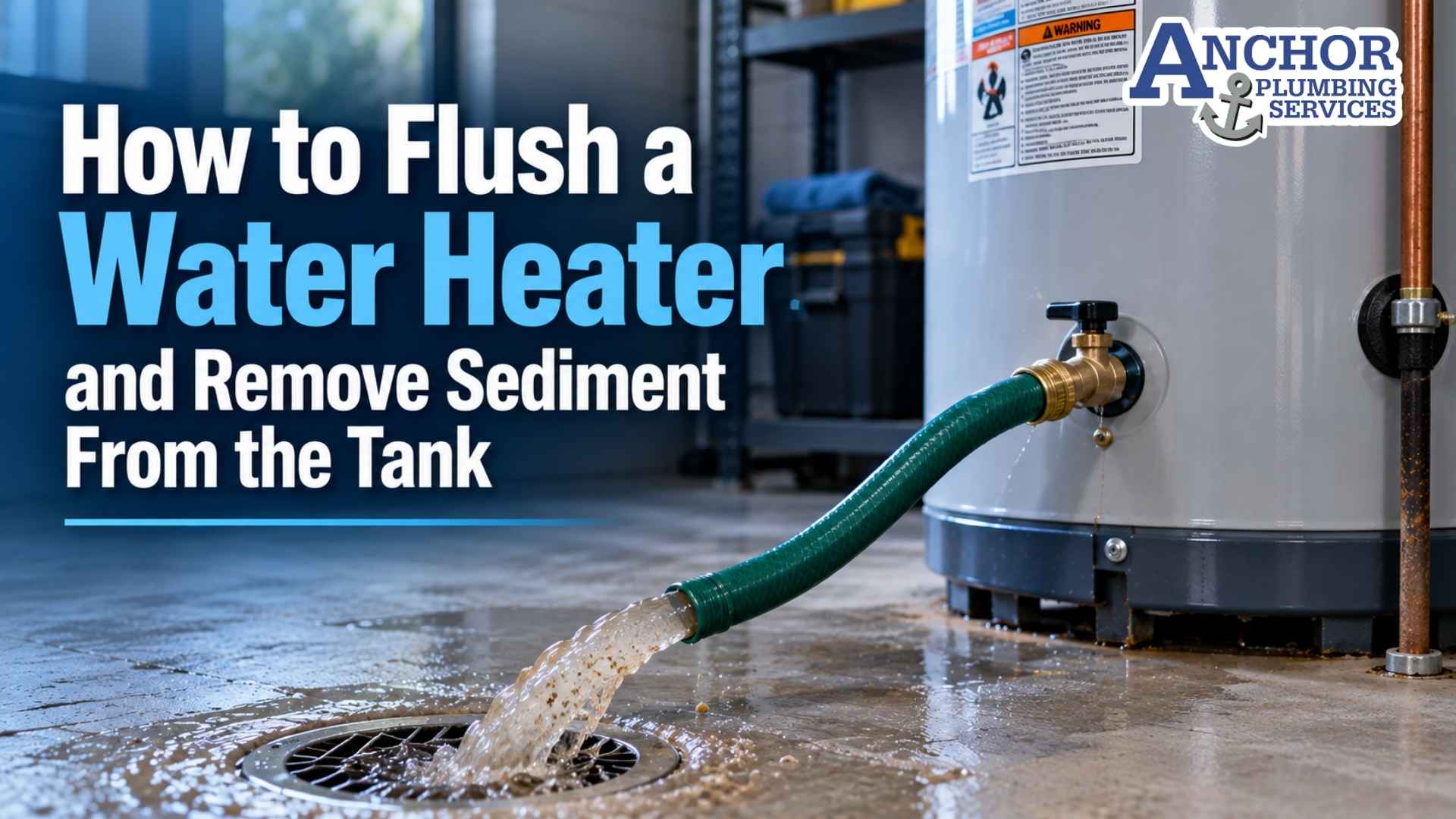
Flushing a water heater pushes fresh water through the tank to scour settled calcium and magnesium off the tank floor. The process takes 30 to 60 minutes for a standard tank and needs only a garden hose, a flathead screwdriver, and a bucket. A flush restores heat transfer between the burner or heating element and the water, which shortens recovery time and extends tank life.
Flushing differs from draining. Draining empties the tank. Flushing runs water through it to carry sediment out. The two go together in a full maintenance cycle, and the step by step water heater draining guide covers the drain procedure, drain valve problems, and how long each tank size takes to empty.
San Antonio homes need flushing every 6 months rather than the annual schedule most national guides recommend. Edwards Aquifer water carries 15 to 20 grains per gallon of hardness, roughly double the national average, which builds sediment at roughly double the rate.
Key Takeaways
|
Is a Water Heater Flush Necessary?
A water heater flush is necessary in any area with hard water, which includes all of San Antonio and surrounding Bexar County. Skipping it produces four measurable outcomes.
- Longer recovery time: Sediment insulates the burner or lower element from the water, forcing longer run cycles to reach the set temperature.
- Higher energy bills: A burner running longer to overcome a mineral barrier consumes more gas or electricity for the same volume of hot water.
- Popping and rumbling noises: Water trapped under the sediment layer boils and releases as steam bubbles forcing through the mineral bed.
- Shortened tank lifespan: Sediment traps heat against the tank floor, which accelerates corrosion and stresses the glass lining. Neglected tanks fail 3 to 5 years earlier than maintained units.
Homes with a whole house water softener see far less sediment because the softener removes calcium and magnesium before water reaches the tank. The water softener cost breakdown for San Antonio homes covers pricing and sizing for homeowners weighing the upfront cost against long term appliance protection.
How Do You Know If Your Water Heater Needs to Be Flushed?
Six signs indicate sediment has built up enough to affect performance.
- Popping, rumbling, or kettling sounds from the tank during a heating cycle. This is the clearest single indicator.
- Hot water runs out faster than it used to, or takes noticeably longer to return after a shower.
- Cloudy water or visible grit at hot water taps, especially on the first draw of the day.
- The burner or heating element runs longer than it did a year ago for the same hot water demand.
- Gas or electric bills climbed without a change in household water use.
- More than 12 months have passed since the last flush, or the tank has never been flushed at all.
A quick diagnostic: draw a bucket of hot water from the drain valve and let it settle for 5 minutes. Sand like grit at the bottom of the bucket confirms sediment accumulation inside the tank.
How Often Should You Flush a Water Heater?
- Flush a water heater every 6 months in San Antonio. National guides recommend annual service, but that assumes hardness near the national average of 7 to 10 grains per gallon. San Antonio Water System supplies Edwards Aquifer water at 15 to 20 grains per gallon, roughly double the national figure.
Situation Frequency Reason San Antonio tank, no softener Every 6 months Edwards Aquifer hardness builds sediment quickly San Antonio tank, with softener Every 12 months Softener removes minerals upstream of the tank Well water, outlying Bexar County Every 4 to 6 months Well water often tests 20 to 30 grains per gallon with iron Tankless unit Every 6 to 12 months Descaling required rather than flushing Tank older than 10 years, never flushed Partial flush only Full flush risks exposing corrosion under the sediment
What Do You Need to Flush a Water Heater?
A standard tank flush needs the same basic tools as a drain.
- Garden hose long enough to reach a floor drain, utility sink, or exterior door
- Flathead screwdriver for drain valves with a slotted stem
- 5 gallon bucket for checking sediment content in the discharge water
- Adjustable wrench for the hose connection
- Work gloves rated for heat
A water heater flush kit bundles a hose, a valve adapter, and sometimes a tank cleaning wand into a single purchase for 25 to 60 dollars. The wand is the useful part. It reaches through the drain port and directs a jet of water at the tank floor, which breaks up compacted sediment that a standard flush leaves in place. Homeowners flushing twice a year get more value from a kit than from repeat standard flushes.
How to Flush a Water Heater in 8 Steps
| Read before starting
Water inside the tank sits at 120 to 140 degrees Fahrenheit. At 140°F, contact causes third degree burns within seconds. At 120°F, prolonged exposure is still dangerous. Shut off the heat source and allow the tank to cool for a minimum of 2 hours before opening the drain valve. |
Step 1: Shut off the heat source
Flushing a gas water heater
Turn the gas control dial to the pilot setting. This keeps the pilot lit while stopping the main burner from firing. A gas water heater left at the normal setting attempts to fire on a low or empty tank, which damages the burner assembly.
Flushing an electric water heater
Switch the breaker labeled water heater to off at the electrical panel. Most electric units run on a dedicated 30 amp double pole breaker. An electric water heater left energized during a flush burns out both heating elements within seconds of the water dropping below them.
Step 2: Let the tank cool for 2 hours
Water holds its temperature for hours after the heat source shuts off. Two hours drops it enough to reduce burn risk at the drain valve. Overnight is safer for anyone uncomfortable working around hot water.
Step 3: Close the cold water inlet and open a hot water faucet
Close the cold water inlet valve at the top of the tank. Then open the hot water side of a faucet elsewhere in the house. The open faucet admits air and prevents a vacuum from forming, which is the most common reason a tank drains slowly or not at all. Leave the faucet open through the whole process.
Step 4: Connect the hose and drain the tank
Thread a garden hose onto the drain valve by hand, then snug it a quarter turn with a wrench. Overtightening cracks plastic valves. Route the hose to a floor drain, utility sink, or outside. Open the drain valve counterclockwise and let the tank empty. A 40 gallon tank takes 20 to 30 minutes.
Step 5: Run the first flush cycle
With the drain valve still open, open the cold water inlet valve. Fresh water enters the top of the tank, stirs up sediment resting on the floor, and pushes it out through the hose. Run this for 3 to 5 minutes.
Step 6: Check the discharge water and repeat
Catch a bucket of water from the hose end. Cloudy water with visible grit means sediment is still clearing. Close the cold water inlet, let the tank drain again, then open the inlet for another cycle. Repeat until the discharge runs clear.
Step 7: Close the drain valve and refill
Close the drain valve clockwise until it stops. Disconnect the hose with a bucket underneath. Open the cold water inlet fully and let the tank fill. The open hot water faucet sputters air while the tank fills, then runs a steady stream once full. A 40 gallon tank fills in 10 to 20 minutes.
Step 8: Restore the heat source and verify
Return the gas control dial to the normal setting, usually 120 degrees Fahrenheit, and relight the pilot if it went out. For electric units, flip the breaker on. Inspect the drain valve and connections for drips, then check again after 30 minutes. Hot water returns to normal temperature within 30 to 60 minutes for gas and 60 to 120 minutes for electric.
How Long Does It Take to Flush a Water Heater?
A standard water heater flush takes 30 to 60 minutes of active work for a 40 to 50 gallon tank. Adding the 2 hour cooling period and the refill brings the complete job to roughly 3 to 4 hours. A tank that has not been flushed in 5 or more years takes longer because each additional cycle adds 5 to 8 minutes.
How Do You Remove Stubborn Sediment From a Water Heater?
Standard flush cycles remove loose sediment. Mineral deposits that have compacted against the tank floor need additional methods.
- Pulse the cold water inlet. Open and close the inlet valve in 20 second bursts with the drain valve open. Pulsing flow breaks up the mineral bed more effectively than steady flow.
- Use a tank cleaning wand. A curved wand attaches to a garden hose and reaches through the drain port to direct water at the tank floor. This is the single most effective DIY tool for compacted sediment.
- Flush through the anode rod port. Removing the anode rod opens a port at the top of the tank that accepts a hose for direct floor washing. This needs typically a 1-1/16 inch socket (some models use 1-1/8 inch) and a breaker bar. Replace the anode rod rather than reinstalling it if it is depleted.
- Apply a descaling solution. Food grade citric acid or white vinegar circulated through the tank dissolves calcium chemically. The solution sits 2 to 4 hours before a final flush.
Sediment that resists all of these has usually hardened into a solid mass, which happens in tanks running 8 or more years without service. At that point the sediment permanently reduces tank capacity and replacement delivers better value than continued cleaning.
Should You Flush a 10 Year Old Water Heater?
Flushing a water heater older than 10 years that has never been serviced carries a real risk of creating a leak. Sediment accumulates in a thick layer across the tank floor over the years. In a tank with advanced internal corrosion, that mineral bed effectively seals thin or pitted spots in the lining. Removing it removes the seal.
The tank held water fine before the flush and develops a slow leak within days after. The corrosion existed already. The sediment was masking it. Four signs indicate elevated risk:
- The tank is 10 years or older with no flushing history.
- Rust colored water comes from hot water taps regularly.
- Visible rust streaks run down the outside of the tank from a seam or fitting.
- Moisture, mineral crust, or rust staining appears around the base.
When any of these apply, run a partial flush of 2 to 3 minutes and stop. This clears loose surface sediment without disturbing the compacted bed. A tank past 12 years with heavy sediment and any rust indicator is usually a replacement candidate rather than a maintenance candidate.
Flushing a tank at the 3 to 5 year mark for the first time is a different situation and carries far less risk. Corrosion has usually not progressed far enough at that age for sediment to be doing structural work. Start with a normal flush and monitor for drips over the following 48 hours.
How Much Does a Plumber Charge to Flush a Water Heater?
A professional water heater flush costs 100 to 250 dollars in San Antonio as a standalone service. Most plumbers bundle the flush into a broader maintenance visit running 150 to 350 dollars, which also covers anode rod testing, temperature and pressure relief valve inspection, burner or element checks, and thermostat verification.
| Service | Typical Cost | What It Includes |
|---|---|---|
| Standard tank flush | 100 to 250 dollars | Drain, 3 to 5 flush cycles, refill, verification |
| Full maintenance visit | 150 to 350 dollars | Flush plus anode rod, TP valve, burner, thermostat |
| Heavy sediment flush | 200 to 400 dollars | Extended cycles, tank wand, possible descaling |
| Tankless descaling | 150 to 300 dollars | Vinegar circulation, filter cleaning, testing |
| Drain valve replacement add on | 75 to 150 dollars | Brass ball valve installed during the flush |
A DIY flush costs nothing beyond a garden hose most homeowners already own. The value of professional service is the inspection that comes with it. A plumber flushing the tank also identifies a depleted anode rod, a failing TP valve, or early corrosion that a homeowner running a hose would not notice.
Can You Flush a Water Heater Yourself?
Most homeowners flush a water heater without assistance. The job needs a garden hose, a screwdriver, and a bucket, with no plumbing modifications. Five situations call for a licensed plumber.
- The tank is 10 years or older with no flushing history. A plumber assesses corrosion risk before disturbing the sediment layer.
- The drain valve is stuck, stripped, or will not open.
- Hot water runs rust colored, which signals internal corrosion that flushing will not fix.
- The tank leaks anywhere, before or after flushing.
- You are uncomfortable working with gas controls or the electrical panel.
Scheduling water heater maintenance in San Antonio twice a year covers the flush along with the anode rod, relief valve, and burner or element checks that determine how many years the tank has left.
How Do You Flush a Tankless Water Heater?
Tankless water heaters store no water, so a standard flush does not apply. Tankless units require descaling, which circulates a vinegar or citric acid solution through the heat exchanger to dissolve mineral scale coating the internal passages.
What a tankless water heater flush kit includes
- Submersible pump rated for at least 4 gallons per minute
- Two washing machine hoses with 3/4 inch fittings
- 5 gallon bucket
- Descaling solution, or 3 to 4 gallons of white vinegar purchased separately
Kits run 60 to 150 dollars. The unit also needs isolation valves already installed on the cold and hot water service ports. Tankless units installed without isolation valves cannot be descaled until a plumber adds them, which costs 200 to 400 dollars.
Tankless descaling steps
- Shut off gas or electrical power to the unit and close the main cold water isolation valve.
- Close the hot water isolation valve and open both service port caps to relieve pressure.
- Connect one hose from the cold water service port to the pump sitting in the bucket. Connect the second hose from the hot water service port back into the bucket.
- Fill the bucket with 3 to 4 gallons of white vinegar and open both service port valves.
- Run the pump for 45 to 60 minutes to circulate the solution through the heat exchanger.
- Turn off the pump, close the service ports, disconnect the hoses, and dispose of the vinegar.
- Open the cold and hot isolation valves and run the unit 5 minutes to flush residual vinegar.
- Clean the inlet water filter screen, restore gas or power, and test hot water at a nearby fixture.
San Antonio tankless units need descaling every 6 to 12 months. Hard water builds scale on the heat exchanger faster than in soft water regions. A scaled heat exchanger loses efficiency, reduces flow rate, and eventually triggers error codes that lock the unit out until service is performed.
Frequently Asked Questions
How do you flush a water heater?
Shut off the heat source, let the tank cool 2 hours, close the cold water inlet, open a hot water faucet upstairs, drain the tank through a garden hose, then reopen the cold water inlet with the drain valve still open. Repeat 3 to 5 minute cycles until the discharge runs clear.
Is it worth flushing a hot water heater?
Flushing extends water heater lifespan by 3 to 5 years and restores recovery performance lost to sediment. In San Antonio, where water hardness runs 15 to 20 grains per gallon, the benefit is larger than in soft water regions because sediment accumulates roughly twice as fast.
Is 3 years too late to flush a water heater?
Three years is not too late. A tank at that age carries moderate sediment and minimal corrosion risk, so a standard flush is safe and worthwhile. Expect 3 to 4 flush cycles before the discharge water runs clear.
Should you flush your water heater if it has never been done?
Flush a tank under 8 years old normally. For a tank 10 years or older that has never been flushed, run only a 2 to 3 minute partial flush and inspect for leaks, because removing sediment can expose corroded spots the mineral layer was sealing.
How much does it cost to flush a water heater?
A professional water heater flush costs 100 to 250 dollars in San Antonio as a standalone service. A full maintenance visit including the flush, anode rod test, and relief valve inspection runs 150 to 350 dollars. A DIY flush costs nothing beyond a garden hose.
How often should you flush a tankless water heater?
Descale a tankless water heater every 6 to 12 months in San Antonio. Edwards Aquifer hardness at 15 to 20 grains per gallon builds scale on the heat exchanger faster than in soft water regions, and a scaled exchanger loses efficiency and flow rate.
What happens if you never flush your water heater?
Sediment accumulates into a layer that insulates the burner or heating element from the water. Recovery time stretches significantly, energy bills climb, the tank develops popping noises, and the unit fails 3 to 5 years earlier than a maintained tank.
Can flushing a water heater cause problems?
Flushing an older neglected tank can expose a leak because the sediment layer may be sealing corroded spots in the tank floor. Tanks 10 years or older with no flushing history should receive a partial flush only, with a leak inspection over the following 48 hours.
Schedule a Water Heater Flush in San Antonio
Anchor Plumbing Services flushes tank and tankless water heaters across San Antonio. A maintenance visit covers the flush along with anode rod testing, temperature and pressure relief valve inspection, burner or heating element checks, and thermostat verification. Every job runs under Master Plumber Gerald S. Cortez (Texas License #41829) with a flat rate written quote before work begins.
Call 210-843-5800 to schedule water heater service in San Antonio or read our 4.9 star plumbing reviews from more than 1,500 customers.