

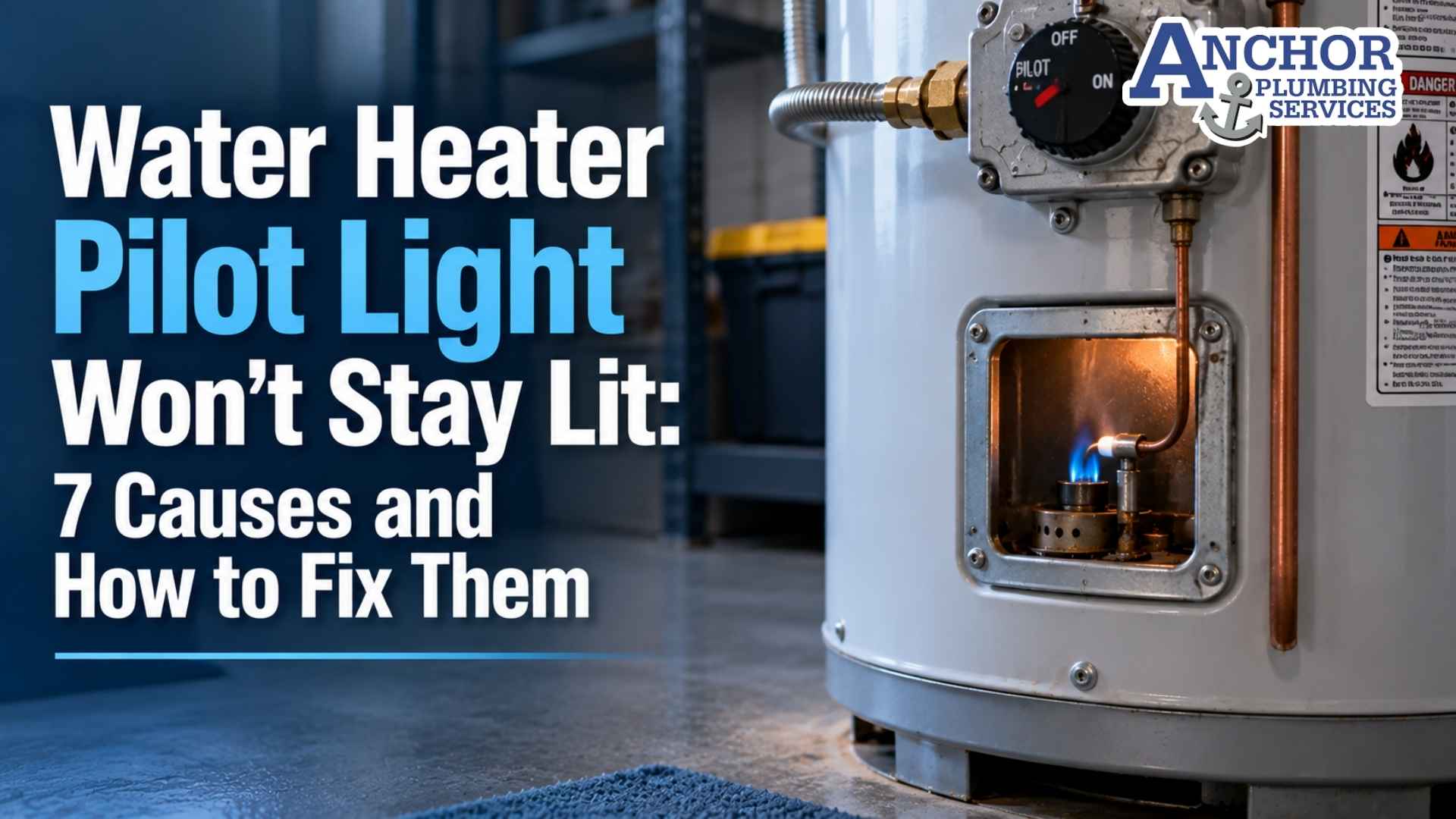
A water heater pilot light that goes out the moment you release the control knob almost always points to a failed thermocouple. The thermocouple is a thin copper rod that sits in the pilot flame and generates a small electrical current telling the gas valve the flame is present. When it stops producing that current, the valve shuts the gas off as a safety measure and the pilot dies.
Six other causes produce the same symptom. A dirty pilot orifice, a clogged flame arrestor screen, a bad gas control valve, a blocked vent, low gas pressure, or a draft in the room can each kill a pilot light that lit fine a moment earlier.
This guide walks through all seven causes in the order a plumber checks them, explains how to test each one, and covers the relight procedure for Rheem, A.O. Smith, Bradford White, and Honeywell control valves.
Key Takeaways
|
Where Is the Pilot Light on a Water Heater?
The pilot light sits inside the burner chamber at the bottom of a gas water heater, behind a small access panel or a sealed viewing window. Look for a round or rectangular cover near the floor, usually on the front of the tank below the gas control valve.
Older units have a removable metal cover you slide or unclip. Newer sealed combustion models built to current FVIR (flammable vapor ignition resistant) standards have a fixed glass or mica viewing window instead of a removable cover. You check the flame through the window rather than opening the chamber.
A healthy pilot flame burns steady blue with a small yellow tip and wraps around the top half inch of the thermocouple. A flame that is yellow throughout, orange, weak, or lifting away from the thermocouple indicates a problem even if it stays lit.
Why Does the Pilot Light Go Out When I Release the Knob?
The pilot goes out when you release the control knob because the thermocouple is not generating enough voltage to hold the gas valve open. Holding the knob down manually overrides the safety circuit and feeds gas to the pilot. Releasing it hands control back to the thermocouple. If the thermocouple output has dropped below roughly 10 millivolts, the valve interprets that as no flame and shuts the gas off.
Three conditions produce a weak thermocouple signal.
- The thermocouple has aged out. Copper thermocouples degrade over 5 to 10 years of heat cycling. Output drops gradually until it falls below the valve threshold.
- The thermocouple tip sits outside the flame. Vibration, a bumped burner assembly, or a sloppy prior repair can shift the tip so the flame no longer wraps it.
- Soot or corrosion coats the tip. A layer of carbon insulates the junction from the heat it needs to generate current.
Hold the knob down for a full 60 seconds before releasing on the next attempt. A thermocouple that is marginal but not dead sometimes needs the extra heating time to reach operating voltage. If the pilot survives at 60 seconds but dies at 30, the thermocouple is on its way out and should be replaced before it fails completely.
What Causes a Water Heater Pilot Light to Keep Going Out?
Seven failures account for nearly every pilot outage. They appear below in the order a plumber checks them, from most common to least.
1. Failed thermocouple
The thermocouple is the most common cause of pilot outage calls. The symptom is specific: the pilot lights and holds while you press the knob, then dies within 1 to 30 seconds of releasing it. A multimeter reading below 10 millivolts across the thermocouple leads confirms the failure. Replacement parts run 10 to 25 dollars and the job takes 30 to 45 minutes.
2. Dirty pilot orifice
The pilot orifice is a small brass fitting that meters gas to the pilot flame. Dust, spider webs, and combustion byproducts narrow the opening over time. A restricted orifice produces a small, weak, or yellow flame that cannot heat the thermocouple properly. The flame may look lit but sits too low or too far from the thermocouple tip.
3. Clogged flame arrestor screen
Water heaters built to current safety standards carry a flame arrestor screen at the base of the tank that prevents flammable vapors from igniting inside the burner chamber. The screen collects lint, pet hair, dust, and drywall debris. A blocked screen starves the burner and pilot of combustion air, which produces a weak or oxygen starved flame. Garage installations near a dryer vent clog fastest.
4. Failed gas control valve
The gas control valve houses the safety magnet that the thermocouple signal holds open. When the magnet or the internal circuitry fails, the valve will not stay open regardless of thermocouple output. This is the diagnosis when a new thermocouple does not solve the problem. Control valve replacement runs 150 to 350 dollars for the part and requires draining the tank on most models.
5. Blocked or downdrafting vent
A gas water heater vents combustion gases through a flue to the outside. A bird nest, debris, a collapsed flue section, or a downdraft pushes exhaust back into the burner chamber. The backdraft smothers the pilot flame and creates a carbon monoxide hazard. Signs include soot marks around the draft hood, a burning smell, and condensation on the tank exterior.
6. Low gas pressure or a partially closed supply valve
Insufficient gas pressure produces a weak pilot flame that cannot heat the thermocouple to operating temperature. Causes include a partially closed shutoff valve, a failing regulator, an undersized gas line serving multiple appliances, or a utility side pressure drop. A pilot that struggles only when the furnace or range runs simultaneously points to a supply capacity issue.
7. Drafts around the water heater
An open exterior door, a nearby HVAC return, a window left open, or high wind across a vent terminal can blow out a pilot flame directly. This cause is easy to identify because the outages correlate with weather or with a door being open rather than occurring randomly.
How to Light a Pilot Light on a Water Heater
The relight procedure varies slightly between manual pilot models and piezo igniter models, but the sequence is consistent across brands.
- Turn the gas control dial to OFF and wait 10 minutes. This clears any unburned gas from the chamber before you introduce a flame. Skipping this step is the most common cause of a flash on relight.
- Locate the pilot access. Remove the outer access panel on older units, or find the viewing window on sealed combustion models.
- Turn the dial to PILOT and press the knob down. This feeds gas to the pilot assembly only.
- Press and hold the piezo igniter button repeatedly while keeping the knob depressed. On manual models, hold a long lighter or a fireplace match at the pilot tube instead.
- Watch for the flame through the window or access opening. Once it lights, keep the knob pressed for a full 60 seconds so the thermocouple reaches operating temperature.
- Release the knob slowly. A pilot that stays lit means the thermocouple is holding the valve open. A pilot that dies means the thermocouple has failed or one of the other six causes is present.
- Turn the dial from PILOT to ON. The main burner should fire within a few seconds if the tank calls for heat.
- Replace the access panel. Hot water returns within 30 to 60 minutes for a standard 40 to 50 gallon gas tank.
Brand specific notes
Rheem water heater pilot light
Most Rheem gas models use a Honeywell or Robertshaw gas control valve with a piezo igniter integrated into the control. The status light on the front of the valve blinks a diagnostic code. A single blink every 3 seconds indicates normal operation. Repeated rapid blinks indicate a thermocouple or thermopile fault. The blink code chart is printed on the label beside the valve.
A.O. Smith water heater pilot light
A.O. Smith units commonly pair a sealed combustion chamber with a viewing window. The pilot assembly is not accessible without removing the burner assembly, which means a dirty orifice requires pulling the burner rather than cleaning in place. The igniter button sits directly below the gas control dial.
Bradford White water heater pilot light
Bradford White Defender series models use a sealed chamber with a screened air intake at the base. Pilot outages on these units frequently trace to a clogged flame arrestor screen rather than the thermocouple. Check the screen before replacing parts. A reset procedure on the ICON control system requires cycling the dial from ON to PILOT four times within a set interval, which is printed on the unit label.
Honeywell gas control valves
Honeywell valves appear across multiple water heater brands and carry a status light that blinks fault codes. Four blinks typically indicates a thermopile or thermocouple voltage problem. Seven blinks typically indicates the gas valve itself has failed. Match the blink count against the chart on the unit label, since codes vary by valve generation.
How Do You Test and Replace a Water Heater Thermocouple?
The thermocouple is the first part to check and the cheapest to replace. Testing takes 10 minutes with a multimeter.
How to test a thermocouple
- Turn the gas control to OFF and let the unit cool for 15 minutes.
- Disconnect the thermocouple lead from the gas control valve using a 3/8 inch wrench. The connection is a threaded nut.
- Set a multimeter to the millivolt DC scale.
- Clip one probe to the thermocouple tip end and one to the threaded connector.
- Reconnect gas temporarily and light the pilot, holding the knob so the flame stays on the thermocouple tip.
- Read the meter after 30 seconds. A healthy thermocouple produces 25 to 35 millivolts. A reading below 10 millivolts confirms failure. A reading between 10 and 20 millivolts means the part is degrading and will fail soon.
How to clean a thermocouple
Cleaning restores output on a thermocouple coated with soot or light corrosion. It does not repair one that has aged out internally, so treat cleaning as a diagnostic step rather than a permanent fix.
- Shut the gas control to OFF and let the assembly cool completely.
- Disconnect the thermocouple from the gas valve and slide it out of the pilot bracket.
- Rub the tip gently with fine steel wool or 400 grit emery cloth until the copper shows clean. Avoid aggressive sanding, which thins the junction.
- Wipe the tip with a dry cloth to remove residue. Do not use water or solvent.
- Reseat the tip in the bracket so the flame will wrap the top half inch, then reconnect the lead and tighten a quarter turn past hand tight.
How to replace a thermocouple
Replacement thermocouples cost 10 to 25 dollars at any hardware store. Bring the old part or the water heater model number to match length, which ranges from 15 to 36 inches. The job takes 30 to 45 minutes.
Shut off the gas at the supply valve, disconnect the thermocouple nut at the control valve, remove the burner assembly if the unit requires it, unclip the old thermocouple from the pilot bracket, seat the new one at the same depth, route the lead back to the valve without kinks, and tighten the connection a quarter turn past hand tight. Overtightening cracks the fitting.
Why Won’t the Pilot Stay Lit Even After Replacing the Thermocouple?
A new thermocouple that does not solve the problem narrows the diagnosis to four possibilities.
- The gas control valve has failed. The internal safety magnet no longer responds to thermocouple voltage. This is the most likely answer when a verified good thermocouple reads 25 millivolts or higher and the valve still closes. Replacement runs 150 to 350 dollars for the part.
- The replacement thermocouple is the wrong length or seated incorrectly. A tip sitting too far from the flame never reaches operating temperature regardless of part quality. The flame should wrap the top half inch of the tip.
- The pilot flame itself is too weak. A clogged orifice or restricted air supply produces a flame that looks lit but delivers insufficient heat. Clean the orifice and the flame arrestor screen before condemning the valve.
- The unit uses a thermopile rather than a thermocouple. Millivolt systems with electronic controls use a thermopile that produces 400 to 750 millivolts. Installing a thermocouple in a thermopile system will not work. Check the parts list for the model.
A plumber confirms the diagnosis by measuring thermocouple output under load, meaning with the lead connected to the valve rather than open circuit. A thermocouple that reads 28 millivolts open circuit but drops to 6 millivolts under load points to a failing valve magnet drawing excessive current.
What If the Water Heater Pilot Won’t Light at All?
A pilot that will not ignite in the first place is a different problem from one that lights and dies. Check these five items in order.
- Confirm gas is reaching the unit. Check that the shutoff valve on the supply line runs parallel to the pipe, which is the open position. Verify other gas appliances in the home still work.
- Check for air in the gas line. A line that was recently serviced or a tank that ran empty on propane needs purging. Hold the knob down for 2 to 3 minutes to bleed air through the pilot tube before attempting ignition.
- Test the piezo igniter. Watch for a visible spark at the pilot tip while pressing the button. No spark means a failed igniter or a disconnected electrode wire. Light manually with a long lighter to confirm the rest of the system works.
- Inspect the pilot tube for blockage. A spider web inside the pilot tube is a common and frequently overlooked cause. Compressed air clears it.
- Look for a tripped safety lockout. Some sealed combustion models lock out after repeated failed ignitions and require a reset sequence before they will accept gas again.
How Much Does It Cost to Fix a Water Heater Pilot Light?
| Repair | Part Cost | Labor | Total |
|---|---|---|---|
| Thermocouple replacement | 10 to 25 dollars | 30 to 45 min | 150 to 300 dollars |
| Pilot orifice cleaning | None | 30 to 60 min | 125 to 250 dollars |
| Flame arrestor screen cleaning | None | 45 to 90 min | 150 to 300 dollars |
| Gas control valve replacement | 150 to 350 dollars | 1 to 2 hours | 350 to 650 dollars |
| Vent or flue clearing | 0 to 100 dollars | 1 to 2 hours | 200 to 450 dollars |
| Diagnostic visit only | None | 30 to 60 min | 75 to 150 dollars |
A gas control valve replacement on a tank older than 10 years rarely makes financial sense. The 350 to 650 dollar repair lands within range of a new water heater installation at 1,200 to 2,500 dollars, and the rest of the tank carries the same age related failure risk.
When Should You Call a Plumber for a Pilot Light Problem?
Thermocouple replacement sits within reach of most homeowners comfortable working around a gas appliance. Five situations call for a licensed plumber.
- You smell gas at any point. Leave the building and call the gas utility from outside before anyone touches the unit.
- The pilot fails again after a thermocouple replacement, which usually means the gas control valve needs diagnosis under load.
- Soot marks appear around the draft hood or the burner chamber, which signals incomplete combustion and a possible carbon monoxide risk.
- The burner flame burns yellow or orange rather than blue, which indicates a combustion air problem.
- You are not comfortable working with the gas supply valve or removing the burner assembly.
A licensed plumber measures thermocouple output under load, tests gas pressure at the valve, inspects the flue draft, and checks the flame arrestor screen in a single visit. Scheduling gas water heater repair in San Antonio resolves the diagnosis in one trip rather than a sequence of parts swaps.
Frequently Asked Questions
Why does my pilot light go out as soon as I release the button?
The thermocouple is not generating enough voltage to hold the gas valve open. Holding the knob overrides the safety circuit manually. Releasing it hands control to the thermocouple, and a reading below 10 millivolts causes the valve to close.
How do you fix a pilot light that keeps going out?
Replace the thermocouple first, since it is the most frequent cause of outages. If the problem continues, clean the pilot orifice and flame arrestor screen, check the vent for blockage, and verify gas pressure. A persistent failure after those steps points to the gas control valve.
How do you clean a thermocouple on a water heater?
Shut off the gas, let the assembly cool, disconnect the thermocouple from the valve, and rub the tip with fine steel wool or 400 grit emery cloth until the copper shows clean. Wipe with a dry cloth, reseat so the flame wraps the top half inch, and reconnect.
How long should you hold the pilot knob down?
Hold the knob down for a full 60 seconds after the pilot lights. The thermocouple needs that time to reach operating temperature and generate enough voltage to hold the gas valve open. Releasing at 20 or 30 seconds is a common reason a relight fails.
Does a tankless water heater have a pilot light?
Modern tankless water heaters use electronic ignition rather than a standing pilot light. Some older tankless models built before roughly 2010 carry a standing pilot. Electronic ignition units light the burner on demand when a hot water tap opens.
Does an electric water heater have a pilot light?
Electric water heaters have no pilot light because they produce heat through resistance elements rather than burning gas. A pilot light exists only on gas fired appliances. An electric unit with no hot water points to a failed element, thermostat, or tripped breaker.
How much does a thermocouple cost for a water heater?
A replacement thermocouple costs 10 to 25 dollars at a hardware store. Professional replacement runs 150 to 300 dollars including the diagnostic visit, the part, and labor. Match the length to the original, which ranges from 15 to 36 inches.
Can a dirty flame arrestor screen cause pilot outages?
A clogged flame arrestor screen starves the burner chamber of combustion air, which weakens the pilot flame until it cannot heat the thermocouple. Garage installations near a dryer vent clog fastest because lint accumulates on the screen at the base of the tank.
Schedule Gas Water Heater Repair in San Antonio
Anchor Plumbing Services diagnoses and repairs gas water heater ignition problems across San Antonio and surrounding Bexar County communities. A technician measures thermocouple output under load, tests gas pressure at the control valve, inspects flue draft, and checks the flame arrestor screen before recommending any part. Every job runs under Master Plumber Gerald S. Cortez (Texas License #41829) with a flat rate written quote before work begins. Same day service is available when the water heater is the only source of hot water in the home.
Call 210-843-5800 to schedule water heater repair in San Antonio or read our 4.9 star plumbing reviews from more than 1,500 customers.