

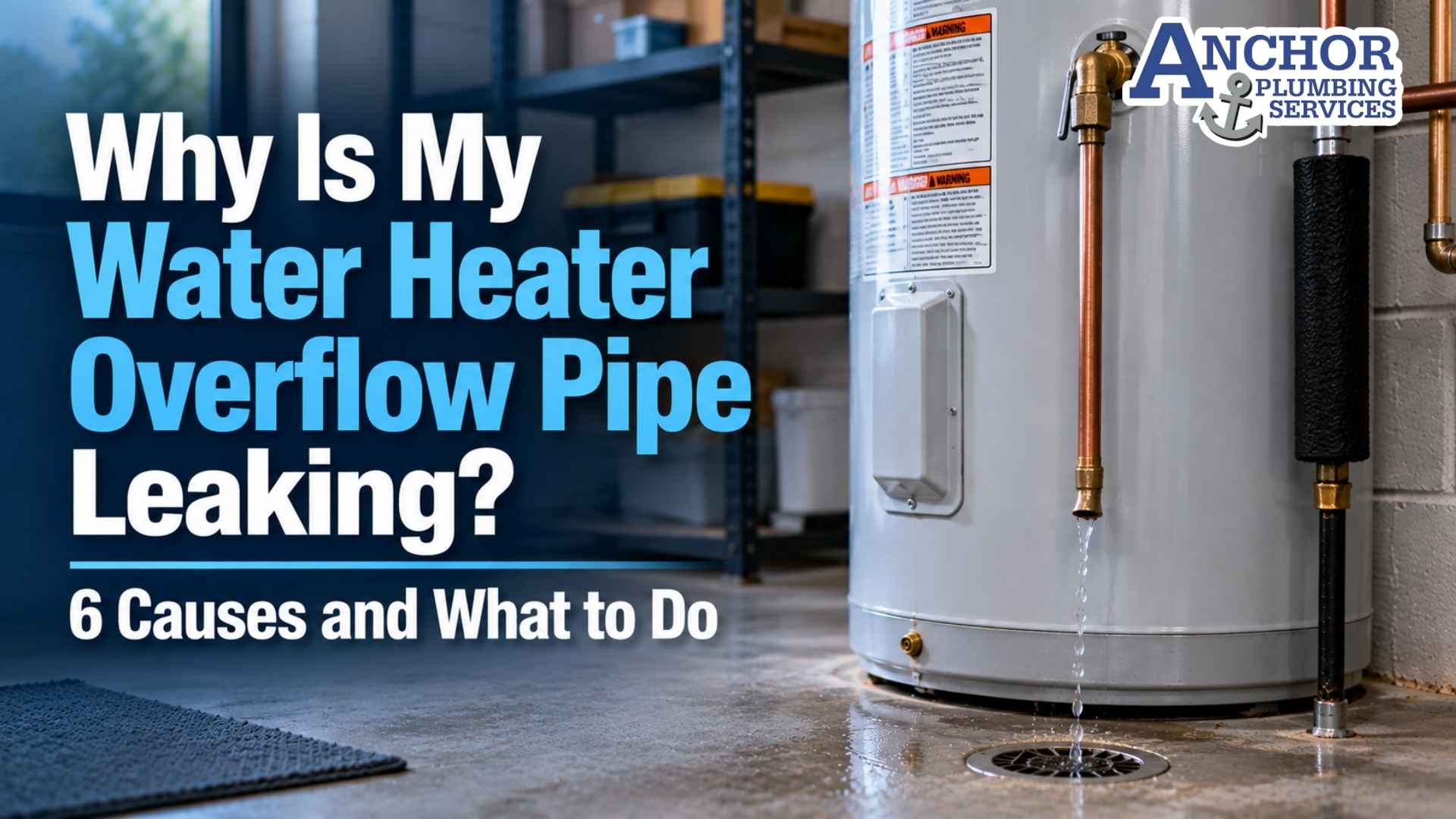
Water dripping from a water heater overflow pipe means the temperature and pressure relief valve has opened. The valve is doing its job. It releases water when tank pressure exceeds 150 PSI or tank temperature exceeds 210 degrees Fahrenheit, which prevents the tank from rupturing.
The question is why the valve opened. Six causes produce a leaking overflow pipe, and they split into two groups. Thermal expansion, high water pressure, and a temperature setting that runs too hot mean the valve responded correctly to a real condition in the system. A worn valve seat, sediment under the valve, or a failed valve mean the valve itself is at fault.
This guide covers how to tell which group you are dealing with, what each fix costs, and why the overflow pipe must never be capped or plugged.
Key Takeaways
|
What Is the Overflow Pipe on a Water Heater?
The overflow pipe is the discharge line attached to the temperature and pressure relief valve, usually called the TPR valve or T and P valve. The valve threads into the top or upper side of the tank. The pipe runs from the valve down the side of the tank and terminates 6 inches above the floor, or routes to a floor drain or the exterior of the home.
Plumbers also call this line the relief valve discharge pipe, the T and P discharge line, or the safety valve drain. The names describe the same component.
How the temperature and pressure relief valve works
The TPR valve contains a spring loaded seat and a temperature probe that extends into the top of the tank. The valve opens under two conditions.
- Pressure exceeds 150 PSI. The spring compresses and the seat lifts, venting water until pressure drops back below the threshold.
- Temperature exceeds 210 degrees Fahrenheit. The probe expands and forces the seat open regardless of pressure, releasing superheated water before it can flash to steam inside the tank.
Both settings are stamped on the valve body. A residential water heater operates normally at 40 to 80 PSI and 120 to 140 degrees Fahrenheit, well below either trigger point.
Overflow pipe code requirements
Plumbing code sets specific rules for the discharge line. A pipe that violates these creates a hazard even when the valve functions correctly.
- The pipe must be the same diameter as the valve outlet or larger, never reduced.
- The pipe must terminate 6 inches or less above the floor, a floor drain, or an approved receptor.
- The end must be plain, not threaded, so no cap or fitting can be attached.
- The pipe must run downhill along its full length with no traps or upward sections that could hold water.
- No valve, restriction, or shutoff may be installed anywhere in the line.
- The material must be rated for the full temperature of the discharge, which rules out standard PVC in most jurisdictions. CPVC, copper, and galvanized steel are accepted.
Is Water Coming From the Overflow Pipe an Emergency?
The answer depends on the discharge pattern and the water temperature. Use the table below to sort the situation.
| What you observe | Urgency | What to do |
|---|---|---|
| Continuous stream, water is very hot or steaming | Emergency | Shut off gas or breaker and the cold water supply. Leave the area. Call a plumber now. |
| Continuous stream, water is warm | Urgent | Shut off the cold water supply and call a plumber the same day. |
| Drips during or shortly after a heating cycle | Address this week | Points to thermal expansion or high supply pressure. Schedule a pressure test. |
| Occasional drip, no pattern | Address this month | Usually a worn valve seat or sediment. Schedule valve replacement. |
| Dripped once after a valve test, then stopped | Monitor | Debris under the seat is common after testing. Watch for 48 hours. |
Steam, a rumbling tank, a bulging tank body, or water hot enough to scald all indicate the temperature safety threshold has been reached. Those conditions call for shutting the unit down immediately rather than diagnosing further.
What Causes a Water Heater Overflow Pipe to Leak?
Six causes account for nearly every overflow pipe leak, listed from most common to least.
1. Thermal expansion in a closed system
Water expands roughly 2 percent in volume when heated from 60 to 140 degrees Fahrenheit. A 50 gallon tank therefore produces about 1 gallon of extra volume during a heating cycle. In an open system that extra water pushes back into the municipal supply line. In a closed system it cannot.
A system becomes closed when a backflow preventer, a check valve, or a pressure reducing valve sits on the incoming water line. San Antonio Water System requires backflow prevention on many residential connections, which makes closed systems common across the service area. With nowhere to expand, pressure climbs during every heating cycle until it crosses 150 PSI and the relief valve vents the excess.
The signature of thermal expansion is timing. The drip appears during or just after a heating cycle and stops between cycles. Pressure readings taken at a hose bib show a normal reading when the tank is idle and a spike above 150 PSI during recovery.
The fix is a thermal expansion tank, not a new relief valve. An expansion tank installed on the cold water inlet gives the extra volume somewhere to go. Installation costs 250 to 500 dollars including the tank and labor. Replacing the relief valve instead treats the symptom and the new valve begins dripping within weeks. The water heater recovery rate guide explains the heating cycle behavior that drives this expansion.
2. High incoming water pressure
Municipal supply pressure above 80 PSI stresses the entire plumbing system and pushes static tank pressure close to the relief threshold before any heating occurs. Adding thermal expansion on top of high static pressure crosses 150 PSI easily.
A screw on pressure gauge at any hose bib costs 10 to 15 dollars and reads static pressure in seconds. Anything above 80 PSI calls for a pressure reducing valve on the main line, which costs 350 to 700 dollars installed. San Antonio’s varied elevation across Bexar County means supply pressure at the meter can vary significantly by neighborhood. Homes in higher demand or lower elevation zones sometimes see pressure well above the 80 PSI threshold..
3. Temperature set too high
A thermostat set above 140 degrees Fahrenheit pushes the tank closer to the 210 degree relief threshold and increases thermal expansion volume per cycle. A failed thermostat that no longer shuts the burner off drives the tank temperature past the trigger point entirely.
Setting the thermostat to 120 degrees Fahrenheit reduces expansion, lowers scald risk, and cuts energy use. Water that scalds at the tap or steams from the overflow pipe indicates the thermostat has failed rather than simply being set high.
4. Worn or corroded valve seat
The relief valve seals against a machined seat. Mineral deposits from hard water, corrosion, and repeated thermal cycling wear that surface over the years. A worn seat no longer seals fully and weeps continuously at normal operating pressure.
San Antonio water at 15 to 20 grains per gallon accelerates this wear. Valves in hard water areas typically need replacement sooner than those in soft water regions — and for San Antonio homes, erring toward the shorter end of the manufacturer’s recommended replacement interval is the safer choice.
5. Sediment lodged under the valve seat
A grain of sediment caught under the seat props the valve open slightly and produces a steady drip. This happens most often within days of testing the valve manually, since lifting the lever pulls debris from the tank into the seat area.
Lifting the test lever fully and releasing it sharply two or three times flushes the debris out in many cases. A drip that persists past 48 hours after this means the seat itself is damaged.
6. Failed relief valve
Valves fail internally through spring fatigue, corrosion of the temperature probe, or mineral fouling of the mechanism. A failed valve either leaks continuously or, more dangerously, seizes closed and provides no protection at all.
A seized valve gives no warning. It simply does nothing when the tank exceeds safe limits. This is why plumbing code and manufacturers call for testing the valve annually and replacing it every 3 to 5 years regardless of visible condition.
How Do You Test a Water Heater Pressure Relief Valve?
Annual testing confirms the valve still moves and can vent under pressure. The test takes 2 minutes.
| Before testing
Water discharging from the pipe during the test reaches full tank temperature, typically 120 to 140 degrees Fahrenheit. Keep hands, feet, and anyone nearby clear of the discharge point. Confirm the pipe terminates safely near a floor drain before lifting the lever. |
- Locate the test lever on top of the relief valve. It is a metal flip lever attached to the valve body.
- Place a bucket under the discharge pipe outlet if the pipe does not terminate over a floor drain.
- Lift the lever fully and hold for 5 seconds. Water should discharge forcefully through the pipe.
- Release the lever and let it snap closed. The flow should stop within a few seconds.
- Watch the discharge point for 5 minutes. A valve that continues dripping has debris under the seat or a worn seat.
- If dripping persists, repeat the lift and release two more times to flush debris. A drip continuing past 48 hours calls for valve replacement.
A valve that produces no water when the lever is lifted has seized closed and provides no overpressure protection. Replace it immediately. A valve older than 5 years should be replaced rather than tested, since the test itself frequently causes an old valve to begin weeping.
Can You Cap or Plug a Leaking Overflow Pipe?
No. Capping, plugging, threading, or installing any valve on the overflow pipe is prohibited by plumbing code and creates a rupture hazard.
The relief valve is the last line of defense against a tank that has lost temperature or pressure control. Blocking the discharge line removes the escape path without addressing the condition that opened the valve. A tank that continues heating with no relief path builds pressure until the weakest point in the shell fails.
Water heated above 212 degrees Fahrenheit under pressure stays liquid only because the pressure holds it there. When the tank ruptures, that pressure drops instantly and the water flashes to steam, expanding hundreds of times in volume. The energy release is enough to launch a tank through a ceiling. Documented failures have destroyed structures.
A dripping overflow pipe is inconvenient. Blocking it converts an inconvenience into a hazard. The correct response is diagnosing why the valve opened and fixing that condition.
How to Tell If the Leak Is From the Overflow Pipe or Somewhere Else
Water pooling near a water heater does not always come from the overflow pipe. Trace the source before assuming the relief valve is at fault, since the repairs differ substantially.
- Dry the area completely and place paper towels at three points: under the discharge pipe outlet, under the drain valve at the base, and around the tank perimeter. Check after 2 hours. The wet towel identifies the source.
- Water at the discharge pipe outlet only means the relief valve opened.
- Water at the drain valve means the drain valve seat is worn or has sediment lodged in it. This is a separate 75 to 150 dollar repair.
- Water around the full tank base with no clear source usually means the tank shell has corroded through. A tank leaking from the bottom cannot be repaired and requires replacement.
- Water at the top fittings means a loose or corroded cold inlet or hot outlet connection, which a plumber can often reseal.
- Condensation on the tank exterior during winter is normal on gas units and clears once the tank reaches temperature.
A tank leaking from the bottom is the most serious finding on this list. Internal corrosion has breached the shell and the failure progresses without warning. Replacement is the only option.
How Much Does It Cost to Fix a Leaking Overflow Pipe?
| Repair | Typical Cost | When it applies |
|---|---|---|
| Relief valve replacement | 150 to 350 dollars | Worn seat, seized valve, or valve past 5 years old |
| Thermal expansion tank installation | 250 to 500 dollars | Closed system with pressure spiking during heating cycles |
| Pressure reducing valve installation | 350 to 700 dollars | Incoming supply pressure above 80 PSI |
| Thermostat replacement | 150 to 350 dollars | Tank overheating past the set point |
| Discharge pipe correction to code | 125 to 300 dollars | Pipe reduced, threaded, trapped, or terminating incorrectly |
| Diagnostic with pressure test | 75 to 150 dollars | Cause unclear, or multiple factors suspected |
| Water heater replacement | 1,200 to 2,500 dollars | Tank leaking from the bottom or shell corrosion |
Diagnosis matters more than the part cost here. Replacing a relief valve on a system with thermal expansion produces a new valve that drips within weeks. A plumber measuring static and dynamic pressure identifies which of the six causes applies before selecting the repair.
When Should You Call a Plumber?
Relief valve replacement sits within reach of an experienced DIY homeowner, but the diagnosis usually does not. Five situations call for a licensed plumber.
- Water discharges continuously or the water is hot enough to scald. Shut the unit down first, then call.
- The drip returns after a relief valve replacement, which points to thermal expansion or high supply pressure rather than the valve.
- Static water pressure at a hose bib reads above 80 PSI, which calls for a pressure reducing valve on the main line.
- Water pools around the base of the tank rather than at the discharge pipe outlet, which may indicate shell corrosion.
- The discharge pipe is reduced, threaded, capped, trapped, or made of a material not rated for the discharge temperature.
A licensed plumber measures static and dynamic water pressure, tests the relief valve under load, inspects the discharge line against code, checks thermostat calibration, and determines whether an expansion tank is required. Scheduling water heater repair in San Antonio resolves the diagnosis in one visit rather than a sequence of parts replacements.
Frequently Asked Questions
Why is my water heater dripping from the overflow pipe?
The temperature and pressure relief valve opened. It releases water at 150 PSI or 210 degrees Fahrenheit. Thermal expansion in a closed plumbing system causes most drips, followed by high supply pressure, a temperature setting above 140 degrees, or a worn valve seat.
Is it normal for a water heater overflow pipe to drip?
Occasional dripping during a heating cycle is common but not normal. It indicates the system is reaching the relief threshold, usually from thermal expansion. Continuous dripping always signals a condition that needs correction.
Can I cap the overflow pipe to stop the leak?
No. Plumbing code prohibits any cap, valve, threading, or restriction on the discharge line. Blocking it removes the tank’s only pressure escape path and creates a rupture hazard. Diagnose why the valve opened instead.
How often should a pressure relief valve be replaced?
Replace a temperature and pressure relief valve every 3 to 5 years. Test it annually by lifting the lever. San Antonio homes on hard water at 15 to 20 grains per gallon reach the replacement point faster because mineral deposits wear the valve seat.
How much does it cost to replace a water heater relief valve?
Relief valve replacement costs 150 to 350 dollars in San Antonio including the part, labor, and testing. The valve itself runs 15 to 40 dollars. A diagnostic visit that includes a water pressure test runs 75 to 150 dollars.
What is the difference between the overflow pipe and the drain pan?
The overflow pipe carries water released by the relief valve. The drain pan sits underneath the tank and catches water from any leak, including tank corrosion or fitting failures. Both route water away from the floor but handle different failure modes.
Does a tankless water heater have an overflow pipe?
Tankless water heaters carry a pressure relief valve with a discharge line, though many models place it on the hot water outlet rather than a tank body. Tankless units produce far less thermal expansion because they store no water, so relief valve discharge is uncommon.
Will an expansion tank stop my overflow pipe from leaking?
An expansion tank stops the leak when thermal expansion is the cause, which applies to closed systems with a backflow preventer or pressure reducing valve on the supply line. It does not help when the leak comes from a worn valve seat, high static supply pressure, or a failed thermostat.
Schedule Water Heater Service in San Antonio
Anchor Plumbing Services diagnoses relief valve discharge across San Antonio and surrounding Bexar County communities. A technician measures static and dynamic water pressure, tests the relief valve, inspects the discharge line against plumbing code, verifies thermostat calibration, and determines whether the system needs an expansion tank or a pressure reducing valve. Every job runs under Master Plumber Gerald S. Cortez (Texas License #41829) with a flat rate written quote before work begins. Same day service is available when water is discharging continuously.
Call 210-843-5800 to schedule water heater repair in San Antonio or read our 4.9 star plumbing reviews from more than 1,500 customers.