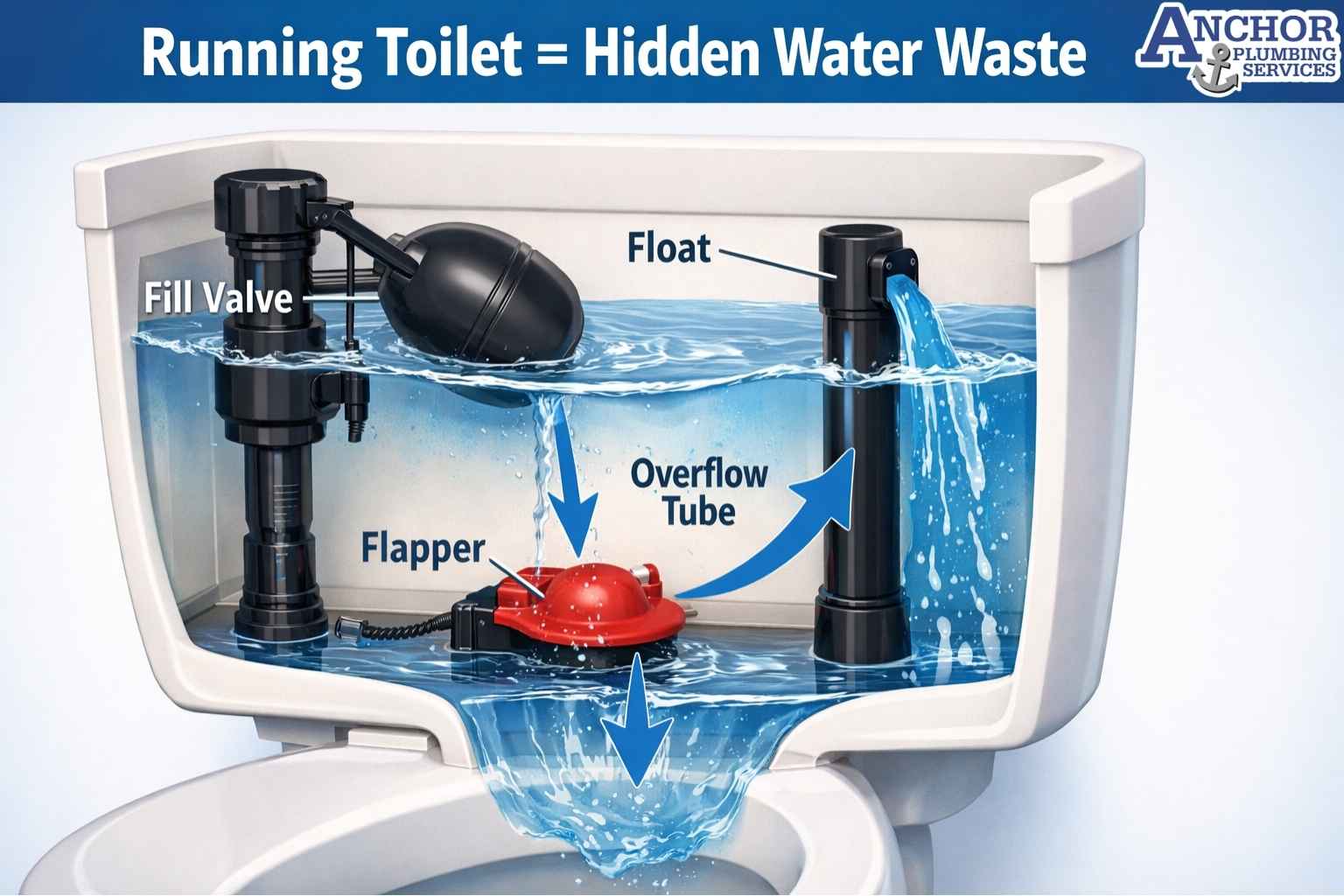

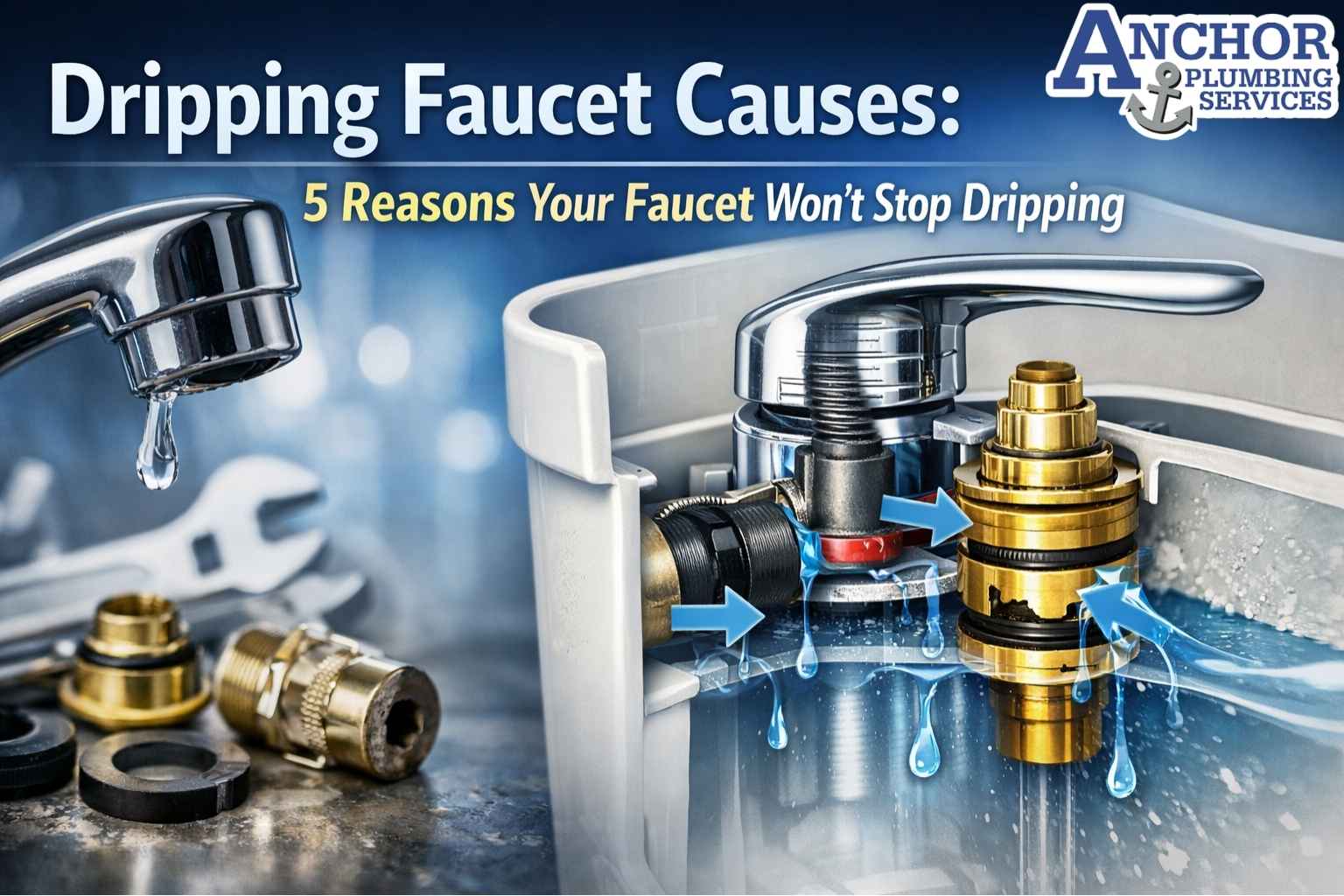
A dripping faucet is usually caused by a worn sealing part inside the faucet valve that no longer blocks water when the handle is off. The five most common causes are a worn washer, a failing cartridge, a damaged O ring, a rough valve seat, or water pressure that keeps forcing water past the seal. These causes vary by faucet type, including compression, cartridge, ceramic disc, and ball faucets.
What Does a Dripping Faucet Usually Mean?
A dripping faucet usually means a sealing surface inside the faucet has worn out, loosened, or cracked, allowing water to pass even when the handle is in the off position.
The drip begins at the valve seal inside the faucet body, not at the spout tip. Water travels through the faucet valve and then exits at the spout because the seal no longer closes fully. The most common failure points are the washer in a compression faucet, the cartridge in a cartridge faucet, the O ring that seals moving parts, and the valve seat where the seal presses to stop flow.
Drips get worse over time because wear increases the gap between sealing surfaces. A constant drip often indicates a seal that no longer closes at all. An intermittent drip often indicates a seal that closes unevenly or a part that shifts as pressure changes. A small drip rate can become faster as the washer softens, the cartridge cracks, or the seat surface becomes more uneven.
Which Type of Faucet Do You Have and Why Does It Matter?
Faucet type determines which internal parts control flow, so the cause of dripping differs between compression, cartridge, ceramic disc, and ball faucets.
You can identify faucet type by the handle style and the way it moves. Compression faucets usually have two handles that turn multiple times to open and close. Cartridge faucets often use a single handle that lifts and rotates. Ceramic disc faucets typically use a single lever that moves smoothly with a short range. Ball faucets are common in older single handle kitchen faucets and use a rounded ball mechanism inside the body.
The faucet type tells you which part is most likely failing. Compression faucets depend on a washer pressing against a valve seat. Cartridge faucets rely on a cartridge seal. Ceramic disc faucets use two ceramic discs that slide to control flow. Ball faucets use springs, seals, and the ball assembly.
Tightening the handle sometimes reduces dripping in a compression faucet because the handle motion increases pressure on the washer. Tightening does not solve most cartridge, ceramic disc, or ball faucet drips because those designs rely on internal seals and fitted parts, not extra handle pressure. If your fixtures show other signs of wear beyond the faucet, the 7 signs it’s time to replace your plumbing fixtures guide covers the full replacement threshold.
Why Won’t a Faucet Stop Dripping? 5 Common Causes
A faucet usually will not stop dripping because a part inside the faucet valve no longer seals water completely when the handle is off.
- Worn washer in a compression faucet
- Failing cartridge in a cartridge faucet
- Damaged O ring around the valve stem or body
- Rough or corroded valve seat that cannot seal
- Water pressure problems that push water past worn seals
Cause 1: Is a Worn Washer Causing the Faucet to Drip?
A worn washer is a common cause of dripping in compression faucets because the washer no longer presses tightly against the valve seat.
The rubber washer sits at the end of the compression valve stem. When you turn a multi-turn handle to the off position, the stem compresses the washer against the valve seat to stop water flow. A drip starts when that washer loses its shape or when the sealing edge becomes uneven.
Washers degrade from repeated friction and pressure. Each open and close cycle rubs the washer surface against the valve seat. Mineral scale can also harden the washer or create an uneven sealing surface. When the washer cannot compress evenly, water passes through the small gap and drips from the spout.
The symptom pattern matches a compression faucet. The handle turns multiple times. The drip often worsens when the handle is tightened hard because extra force distorts the washer and can damage it faster. The fix path is direct — replace the washer and inspect the valve seat. A damaged seat can cause a new washer to fail early, so seat condition matters in the same repair step.
Cause 2: Can a Worn Cartridge or Ceramic Disc Insert Cause Dripping?
Yes. A worn cartridge or ceramic disc insert can leak when internal seals, discs, or spring mechanisms fail to close fully.
Cartridge and ceramic disc faucets rely on precision closure. A cartridge uses internal seals and ports that align to block water when the handle is off. A ceramic disc faucet uses two smooth discs that slide against each other to open and close flow. Both designs depend on tight tolerances. Small wear, a torn seal, or a cracked cartridge body can prevent full closure and allow a constant drip.
Debris and scale also interfere with closure. Fine grit or mineral buildup can block a disc surface or a cartridge port so the sealing face cannot sit flat. The symptom pattern is often a single handle faucet with a drip that can be steady even when the handle feels fully off.
The fix path is model specific. Many cartridge drips require cartridge replacement because internal seals are not serviceable. Ceramic disc faucets sometimes respond to cleaning and flushing, but worn discs or damaged seals require insert replacement. Matching the correct cartridge or disc kit to the faucet model is the key step because size and port layout vary by manufacturer. San Antonio’s hard water accelerates cartridge wear — understanding how hard water affects your plumbing explains why mineral buildup shortens cartridge and disc lifespan in this area.
Cause 3: Is a Damaged O Ring or Gasket Leaking Water Inside the Faucet?
A damaged O ring or gasket can cause internal leakage that shows as dripping from the spout or leaking around the handle base.
O rings and gaskets seal moving joints inside the faucet. Common locations include the handle stem, the spout base, and the cartridge housing. These seals prevent water from escaping into the faucet body when the handle moves or when the spout swivels. When an O ring dries out, flattens, or cracks, it loses elasticity and water leaks past the seal.
The symptom pattern often includes more than a spout drip. You may see moisture around the handle base, water collecting under the faucet, or a drip that changes when you move the handle. A leak at the handle base points to stem seals. A leak near the spout base points to spout O rings.
The fix path is replacement plus correct lubrication. Remove the handle and replace the O ring or gasket with the correct size. Apply plumber-safe silicone grease to reduce friction and extend seal life. Petroleum-based lubricants can damage rubber, so the grease type matters.
Cause 4: Can a Corroded or Damaged Valve Seat Cause a Dripping Faucet?
Yes. A corroded or pitted valve seat prevents a tight seal, allowing water to pass even when the faucet is off.
The valve seat is the sealing surface inside the faucet body where the washer or cartridge presses to stop water. If the seat surface is smooth and intact, the seal closes fully. If the seat is rough, pitted, or coated with limescale, the sealing surface becomes uneven and water finds a path through the gaps.
Hard water minerals and corrosion are common causes of seat damage. Mineral scale creates a rough surface that prevents full contact. Corrosion creates pits that cut the sealing edge. This cause often appears when a washer replacement does not stop the drip. A new washer cannot seal against a damaged seat.
The fix path is seat restoration or replacement. Some faucets have a removable seat that can be replaced. Others require resurfacing with a seat tool to restore a smooth sealing face. Seat work prevents repeat washer failures and restores a stable seal. Limescale buildup on valve seats is a direct consequence of hard water — the 3 ways to prevent limescale in your home covers how to slow mineral accumulation on fixtures and internal faucet components.
Cause 5: Could High Water Pressure or a Failing Shutoff Valve Keep the Faucet Dripping?
High water pressure or a partially failing shutoff valve can worsen dripping by pushing water past worn seals and preventing full isolation during repairs.
Water pressure adds load to every sealing surface inside the faucet. When pressure is high, a small imperfection in a washer, cartridge seal, or valve seat allows more water to pass. This makes a minor drip appear larger and can make it return soon after a partial repair. Pressure problems can also show up as multiple fixtures dripping or as drips that worsen during peak demand periods when pressure fluctuates.
A local shutoff valve — also called an angle stop valve under the sink — can create confusion during troubleshooting. If the angle stop does not close fully, water can still feed the faucet during repair attempts. That creates the impression that a cartridge or washer replacement failed even when the part is correct.
The fix path depends on scope. If multiple fixtures show pressure-related issues, test household PSI and evaluate the pressure regulator. If the issue is limited to one faucet and the angle stop will not isolate the line, replace the angle stop valve so repairs can be performed safely. Pressure issues that affect multiple fixtures often share the same root cause — why water pressure is low in your house covers the diagnostic process for whole-home pressure problems.
How Can You Diagnose the Cause of a Dripping Faucet in 3 Quick Checks?
You can narrow the cause by identifying faucet type, checking where the leak appears, and noting whether the drip changes with handle position or water pressure.
Identify faucet type. A multi-turn handle points to a compression faucet with a washer and valve seat. A single handle faucet usually uses a cartridge, a ceramic disc insert, or a ball assembly. Faucet type determines which internal parts seal the water path and which parts fail most often.
Locate the leak. A drip from the spout tip usually means a sealing surface inside the valve is not closing fully. Moisture at the handle base often points to an O ring or gasket issue around the stem or cartridge housing. Water under the sink often points to the angle stop valve, supply line connection, or the faucet body connection points.
Observe the pattern. A constant drip often indicates a worn seal that cannot close at all. An intermittent drip often indicates a seal that closes unevenly or shifts with pressure changes. A drip that changes when other fixtures run can indicate pressure load changes or a restriction that affects how the valve seals. These 3 checks isolate the likely cause before you remove parts.
When Is It Better to Repair a Dripping Faucet vs Replace the Faucet?
Repair is usually best when the faucet body is intact and parts are available, while replacement is often better when corrosion, repeated failures, or unavailable cartridges make repair unreliable.
Repair works best when the issue is minor wear and the repair parts are common. Examples include a compression faucet washer, a seat spring, or an O ring that matches a standard size. Repair also makes sense when the faucet finish is intact and the valve body shows no internal corrosion.
Replacement is often the better choice when the faucet has internal corrosion, when cartridges fail repeatedly, or when the model uses an obsolete cartridge that is no longer available. A practical rule is to consider replacement when the faucet has needed multiple repairs in a year and the drip returns quickly after each repair.
Prevention reduces repeat dripping. Clean aerators periodically to prevent debris from damaging seals. Keep home water pressure stable because high pressure increases load on sealing surfaces and shortens part life.
When Should You Call a Plumber for a Faucet That Won’t Stop Dripping?
Call a plumber when the shutoff valve won’t close, the leak is at the handle or body, the faucet is corroded, or the drip persists after a basic part replacement.
Use a clear stop rule. 1 repair attempt is the limit for most homeowners because repeated disassembly increases the chance of stripped threads, cracked fittings, and new leaks.
Call a plumber when any of these conditions apply:
- Angle stop valve will not shut off water
- Leak appears at the valve body or under the sink
- Drip continues after washer or cartridge replacement
- Corrosion or mineral locking prevents safe disassembly
- Water pressure issues appear across the home and affect multiple fixtures
A burst pipe or active leak that originates near faucet supply lines requires immediate attention — what to do when a burst pipe occurs covers the emergency steps before a plumber arrives.
How Does Anchor Plumbing Services Fix Dripping Faucets and Prevent Repeat Leaks?
Anchor Plumbing Services fixes dripping faucets by inspecting the faucet type, diagnosing the sealing failure, providing a written flat-rate quote, completing the repair, and testing for a leak-free result before closing the job.
Inspect starts with leak location and faucet design. The technician checks whether the drip is coming from the spout tip, the handle base, or under the sink. The faucet type is identified because compression, cartridge, ceramic disc, and ball faucets fail in different ways.
Diagnose focuses on the exact sealing surface that is leaking. This includes washers, cartridges, O rings, gaskets, and valve seats. Shutoff valves under the sink are also checked because an angle stop that does not close fully prevents safe repairs and can cause a drip to appear unresolved.
Quote comes before work begins. Anchor Plumbing Services uses flat-rate pricing with Master Plumber oversight, so you know the scope and cost before the repair starts.
Repair can include faucet repair, cartridge replacement, valve seat work, and angle stop replacement. When multiple fixtures show leak and pressure symptoms, a pressure regulator evaluation is used to identify pressure load that shortens seal life.
Test is the final step. The faucet is run through open and close cycles and checked for stable flow and a dry valve body, with confirmed leak-free performance at the spout and handle base.
What Is the Safest Next Step If Your Faucet Keeps Dripping?
The safest next step is to shut off the under-sink valve, confirm the faucet type, and replace the most likely sealing component — then call a plumber if the shutoff fails or the drip continues.
- Turn off the angle stop valve under the sink to stop water flow to the faucet
- Confirm whether the faucet is a compression, cartridge, ceramic disc, or ball design — that determines the part that seals water
- Replace the most likely sealing part: a washer for compression faucets or a cartridge for most single handle faucets
- Stop the repair and call a plumber when the shutoff valve will not fully close, the faucet body is corroded, or the drip continues after the first part replacement
Need a Dripping Faucet Fixed in San Antonio?
Anchor Plumbing Services diagnoses and repairs dripping faucets across San Antonio, Helotes, Stone Oak, New Braunfels, and surrounding areas. Every repair is performed by a Texas-licensed technician under Master Plumber oversight with a flat-rate written quote before work begins. Call Anchor Plumbing Services or book online to schedule your repair today.